IR-64 Rice Exporter in India: What Buyers Should Know
Practical guidance on specifications, broken percentage, sourcing, and quality assurance for IR-64 parboiled rice exports from India.
IR-64 parboiled rice is one of India's most widely exported non-basmati rice varieties, favored by bulk buyers for its consistent quality, competitive pricing, and strong demand across African and Gulf markets. For importers searching for a reliable IR-64 rice exporter in India, the key is not just finding a seller — it is finding a supplier who understands grain specifications, sourcing seasonality, quality control discipline, and export documentation from origin to destination.
This article is based on direct mill visits across North Odisha, the West Bengal border belt, and research across the broader Eastern India sourcing corridor — covering what buyers should know before placing an order for IR-64 parboiled rice from India.
Why IR-64 Parboiled Rice Is Popular in Export Markets
IR-64 parboiled rice is valued internationally because it balances affordability with acceptable cooking quality for large-scale consumption. In export trade, that balance matters more than premium branding — especially for government tenders, wholesalers, distributors, and institutional buyers across Africa and the Middle East.
Another reason IR-64 is important is consistent availability. India has a strong rice export ecosystem, and IR-64 remains one of the varieties that IR-64 rice exporters in India can source and ship in bulk when the supply chain is properly organized. This makes it a reliable option for importers who need repeat shipments rather than one-time purchases.
Specifications Buyers Should Confirm
When sourcing IR-64 parboiled rice from an IR-64 exporter in India, buyers should confirm the following parameters before finalizing any order:
| Parameter | What to Look For |
|---|---|
| Grain type | Long-grain non-basmati, parboiled |
| Grain length | Average 5.8 to 6.2 mm |
| Broken percentage | 5%, 10%, or 25% — confirm target spec clearly |
| Moisture | Maximum 14% for export standard |
| Admixture | Minimal — low stone, dust, and foreign matter |
| Processing | Clearly specify parboiled, not raw |
These details affect both the commercial value of the shipment and how well the rice performs in the destination market.
Broken Percentage Explained
Broken percentage is one of the most important commercial specifications in IR-64 rice exports from India. Lower broken rice commands higher prices. Higher broken rice serves volume-driven and processing markets.
Common IR-64 broken specifications in export trade:
- 5% broken — premium parboiled grade, suitable for retail and higher-end bulk markets. This is the most common specification for East African and Gulf buyers.
- 10% broken — widely used for standard bulk export, balancing price and quality.
- 25% broken — lower-cost option for large-volume buyers, food processing, or institutional supply.
Buyers should clarify their target broken percentage before engaging any IR-64 rice exporter in India. A mismatch in this single parameter can affect pricing, buyer acceptance, and downstream sales.
Sourcing Regions for IR-64 in Eastern India
IR-64 stock availability in eastern India is shaped by geography, agro-climatic conditions, and milling infrastructure. Understanding which regions produce what — and when — helps buyers make better sourcing decisions.
North Odisha — Balasore and Mayurbhanj
North Odisha, including Balasore and Mayurbhanj, has an established milling base with strong operational capacity. Mills in this corridor have been processing parboiled rice for decades and have direct experience with export-oriented output. Balasore sits on a well-connected logistics corridor with road access to Visakhapatnam port, making inland movement efficient for export cargo.
West Bengal Border Belt — Dantoon near Jaleshwar
The Dantoon area in West Bengal, close to the Odisha border near Jaleshwar, is closely integrated with the North Odisha supply chain. Mills here process Swarna and IR-64 type varieties and feed into the same export corridors as North Odisha mills. For IR-64 exporters operating across eastern India, this border belt extends sourcing flexibility without a significant logistics cost increase.
Western Odisha — Kalahandi and Nuapada
Western Odisha, particularly Kalahandi (Bhawanipatna) and Nuapada, holds some of the highest IR-64 stock concentrations in the state. These districts benefit from better water availability, favorable soil conditions, and high paddy yields per hectare. Mills here tend to be larger, with higher processing throughput and better capacity for consistent large-volume export orders.
Chhattisgarh
Chhattisgarh provides a year-round supply advantage that Odisha's seasonal cycle does not always offer. For IR-64 exporters in India managing buyer commitments across the full calendar year, Chhattisgarh sourcing fills the gap during Odisha's off-season months.
Mill Technology and Processing Standards
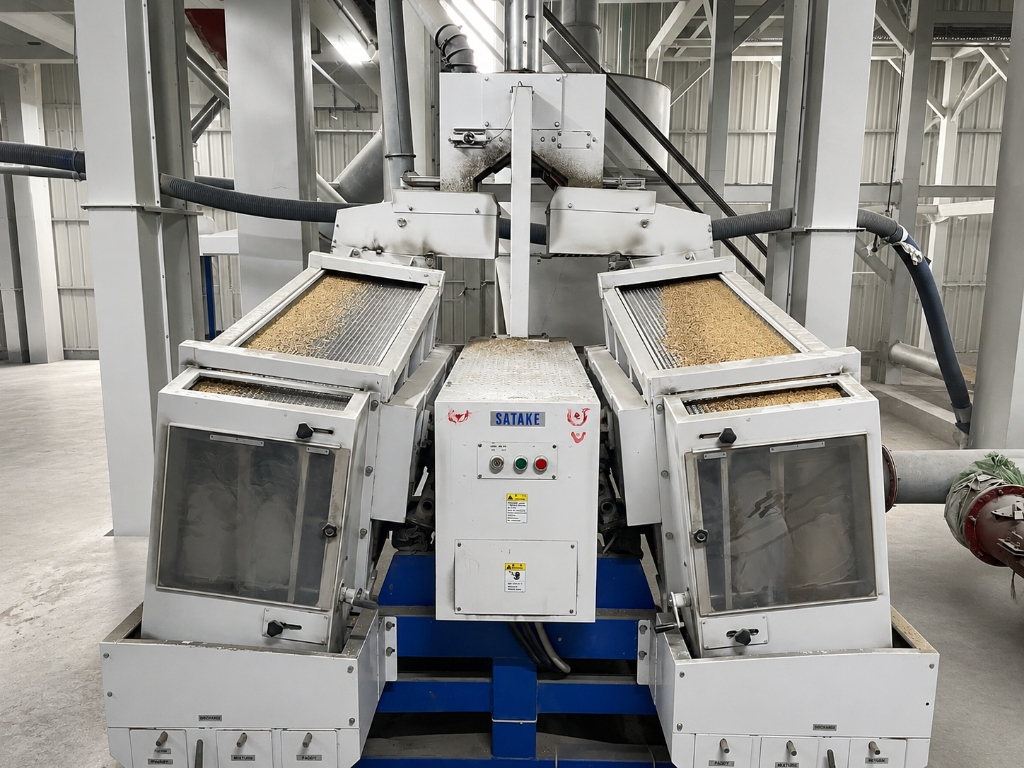
Every serious export-aligned mill in this belt now operates sortex machines, polishing lines, and grading equipment. However, the scale and throughput capacity vary significantly.
Larger mills in Western Odisha — Kalahandi and Nuapada — run high-capacity sortex lines with multiple polishing units. This gives tighter grain uniformity, more consistent broken percentage, and better visual quality across batches.
Mills in North Odisha and the West Bengal border belt are operationally reliable with established export experience, and they work well for standard volume requirements with proper pre-shipment verification in place.
Export-Oriented vs Government-Procurement Mills
Not every mill in Odisha is available for commercial export orders. A significant portion of Odisha's milling capacity operates under government paddy procurement schemes — sourcing paddy from government channels and milling for public distribution. These mills are not flexible for private export buyers.
The mills relevant for IR-64 rice exporters in India are the open-market mills that source paddy commercially, maintain private stock, and can commit to packaging specifications, lead times, and export documentation. Identifying these mills and building relationships with their owners is the core sourcing work that separates reliable exporters from price-sheet aggregators.
At Kalinga Foods, our sourcing network is built entirely around open-market, export-capable mills across North Odisha, Western Odisha, the West Bengal border belt, and Chhattisgarh.
Three-Level Quality Control — How We Protect Every Shipment
Quality control is where most IR-64 rice exporters in India cut corners. We do not. Every shipment goes through three distinct QC layers.
Level 1 — Upcountry Mill Inspection (Third Party)
Before the rice leaves the mill, we engage Cotecna Inspection India — a globally recognized third-party inspection agency — to conduct upcountry inspection at the mill itself. This includes:
- Physical sampling from multiple lot sections
- Moisture content measurement using calibrated instruments
- Broken percentage verification against buyer specification
- Bag weight confirmation on random sampling
- Visual inspection for foreign matter, discolouration, and chalky grains
- Photography documentation throughout the process
This stage catches problems before the rice moves. A lot that fails at the mill gate costs a fraction of what a failed shipment costs at destination.
Level 2 — Port Pre-Shipment Inspection (Third Party)
At Visakhapatnam port, Cotecna conducts a second inspection at the Container Freight Station before container sealing. This includes:
- Supervision of container stuffing
- Random composite sampling during loading
- Weighment witnessing on calibrated weighbridge
- Container cleanliness verification before stuffing begins
- Seal number recording on sealed container
This second checkpoint ensures that what left the mill is what goes into the container — and that the container itself is suitable for export cargo.
Level 3 — Government Mandatory Inspection (RCAC/APEDA)
For all non-basmati rice exports from India, RCAC inspection by APEDA is mandatory under government regulation. The RCAC inspector takes official samples at the port, which are tested in an accredited lab for pesticide residue, moisture, and broken percentage. The phytosanitary certificate is issued by the Plant Quarantine Officer at port.
No shipment can be exported without these government certificates. They are not optional. They are part of every legitimate IR-64 export from India.
This three-level QC structure — third-party at origin, third-party at port, and government certification — is what gives buyers confidence that what they ordered is what arrives.
Export Documentation for IR-64 Rice
For IR-64 parboiled rice exports from India, buyers should expect the following standard documentation set:
- Commercial Invoice and Packing List
- Bill of Lading
- Certificate of Origin
- Phytosanitary Certificate
- RCAC Inspection Certificate
- Fumigation Certificate
- Marine Insurance Certificate
- Non-GMO Certificate where required by the destination country
Experienced IR-64 rice exporters in India handle this documentation as part of standard execution. Buyers who work with first-time or informal exporters often face delays, missing documents, or compliance gaps that hold up customs clearance at destination.
Visakhapatnam — Primary Export Port
For North Odisha and West Bengal border belt sourcing, Visakhapatnam (Vizag) in Andhra Pradesh is the primary export port. While Haldia port is used by some West Bengal-based exporters, local handling costs and operational complexity at Haldia run significantly higher than at Vizag. For most commercial rice export calculations, Vizag offers better cost efficiency, stronger vessel connectivity to African and Gulf routes, and a well-established CHA and freight forwarding ecosystem specifically experienced in rice export cargo.
Common Buyer Mistakes When Sourcing IR-64
Comparing exporters only on price is the most common mistake. The cheapest quote can become the most expensive shipment if the supplier misses timelines, delivers inconsistent quality, or cannot support required documentation at destination customs.
Not confirming packaging and branding requirements early is the second common mistake. Some buyers need private-label bags. Others need standard bulk export packing. Defining these upfront avoids production delays and cost disputes.
Not asking about QC process is the third. Any IR-64 rice exporter in India who cannot describe their pre-shipment inspection process in specific terms — agency name, inspection stages, what gets tested — is a supplier to be cautious about.
Buyer Checklist Before Placing an Order
Before confirming an order with any IR-64 rice exporter in India, verify:
- Rice type confirmed as IR-64 parboiled, not raw.
- Broken percentage clearly specified — 5%, 10%, or 25%.
- Grain length and moisture limits agreed in writing.
- Packing size and bag printing requirements confirmed.
- Port of shipment and Incoterm agreed — FOB Vizag or CIF destination.
- Documentation set confirmed including any country-specific certificates.
- Lead time and mill availability confirmed against your shipment window.
- Third-party QC process confirmed with agency name and inspection stages.
How We Work at Kalinga Foods
At Kalinga Foods, we are an IR-64 rice exporter in India sourcing directly from open-market mills across North Odisha, Western Odisha, the West Bengal border belt, and Chhattisgarh. We do not work through aggregators or brokers — every mill in our network is a direct relationship built on consistent volume and quality discipline.
Our sourcing approach is order-matched rather than stock-dependent. When you place an order, we match it to the right mill based on volume requirement, quality specification, and shipment timeline — not based on what happens to be available in one location.
Every shipment includes three-level QC: Cotecna upcountry inspection at the mill, Cotecna pre-shipment inspection at Vizag port, and mandatory government RCAC and phytosanitary certification.
If you are evaluating IR-64 rice exporters in India for your market requirements, the right conversation starts with your specification, quantity, destination port, and shipment timeline.
Frequently Asked Questions
What is IR-64 parboiled rice and why is it popular for export?
IR-64 is a long-grain non-basmati rice variety that undergoes parboiling — soaking, steaming, and drying before milling. It is popular for export because it offers consistent quality, competitive pricing, and strong demand in African and Gulf bulk markets. IR-64 rice exporters in India supply it widely to East Africa, the Middle East, and parts of Southeast Asia.
What broken percentage should I order for my market?
For retail and premium bulk markets, 5% broken is standard. For standard bulk export, 10% broken is widely used. For food processing or cost-sensitive large-volume buyers, 25% broken is the typical specification. Confirm your market requirement before engaging any IR-64 exporter in India.
Which region in India is best for sourcing IR-64?
Eastern India — specifically Odisha, the West Bengal border belt, and Chhattisgarh — is one of the strongest sourcing corridors for IR-64. Within Odisha, Kalahandi and Nuapada in the west have high stock volumes and large-capacity mills. North Odisha including Balasore has established export-oriented mills with good logistics access to Visakhapatnam port.
Which port is used for IR-64 rice exports from Odisha?
Visakhapatnam (Vizag) is the primary export port for Odisha and the West Bengal border belt. It offers better cost efficiency and vessel connectivity for African and Gulf routes compared to Haldia port.
What quality certificates come with an IR-64 shipment from India?
A standard IR-64 shipment includes the Phytosanitary Certificate, RCAC Inspection Certificate, Certificate of Origin, Fumigation Certificate, and Marine Insurance Certificate. A Non-GMO Certificate is also available when required by the destination country.
How do I verify that a supplier has proper QC in place?
Ask the supplier to name their third-party inspection agency and describe their inspection stages. A serious IR-64 rice exporter in India will be able to confirm the agency name, the inspection checkpoints — at mill and at port — and the government RCAC certification process. If they cannot answer this specifically, that is a risk signal.
What is the minimum order quantity for IR-64 parboiled rice from India?
Most IR-64 exporters in India work with a minimum of one 20-foot container, which holds approximately 25 metric tonnes of rice in 50kg PP bags. Some suppliers accept smaller trial quantities, but one container is the practical minimum for export economics to work for both buyer and supplier.
Can I get private-label packaging for IR-64 rice?
Yes. Private-label PP bags with custom printing are available from most export-oriented mills. Minimum quantity requirements for custom printing vary by mill — typically one container minimum. Confirm bag size, printing design, and lead time when placing your order.
Discuss rice export requirements
For IR-64 rice, Swarna rice, parboiled rice, or Odisha sourcing for your market, share your specifications and shipment plan with our team.
Send Rice Inquiry